DatingRing - provides impartial dating reviews &
advice to millennials and adults to help them succeed with online dating.
The content on our website is based on individual experience and research.

 DatingforLove
Figuring out your sexuality and finding love and support can be tricky at times, and sometimes it can be tricky for those supporting someone still figuring out their sexual orientation. Read up about what it means to be bisexual and how to find the support you need within the UK community.
“I call myself bisexual because I acknowledge that I have in myself the potential to be attracted—romantically and/or sexually—to people of more than one sex and/or gender, not necessarily at the same time, not necessarily in the same way, and not necessarily to the same degree.” — Robyn Ochs
This definition by bisexual activist Robyn Ochs sums up brilliantly what being bisexual is—and what it is not.
Some men and women who refer to themselves as bi-sexual say they are only attracted to heterosexual men and women (cisgender). As you can’t necessarily tell if someone is straight, gay, or transgender, however, this may not be an entirely true statement, though it may be true that in their experience they have only ever been attracted to people whom they know to be straight. Others say they are attracted to people with a mixture of different sexual orientations and genders, such as gay, straight, queer, and transgender people, which sometimes mean they prefer to refer to themselves as pansexual, or pansexual and bi.
Also, many bi-sexual people define themselves as non-binary or transgender.
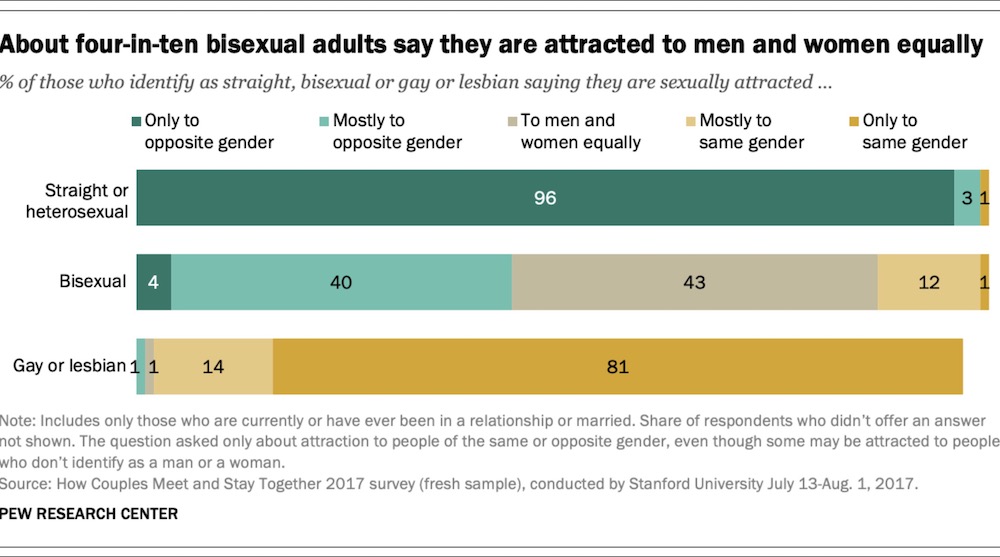
Not everyone who is bi likes different genders equally. Research in the UK and internationally has found that about 43% who associate with being bi are equally attracted to men and women. 40% say they are more attracted to the opposite sex than same sex, while 4% say they are only attracted to the opposite gender. 12% say they are attracted mostly to their own gender, while 1% say they are only attracted to their own gender. About 88% of bisexuals who are married are married to someone of the opposite sex.
As you can see, this study did not seem to account for attraction to non-cisgender people—some people who identify as being more attracted to the opposite or same sex may still be attracted to non-cisgender people, too.
If you are bisexual and define yourself as a woman, marrying a man does not turn you straight. You can still feel attracted to both men and women, or other genders, depending on what your sexual preferences are. Similarly, a straight woman marrying a man won’t stop being attracted to other men just because she’s married—she simply chooses to be in a, potentially, monogamous marriage with one man.
On social media, you’ll find many people in the UK using the hashtag #StillBisexual to let the world know that they are not “taking sides” just because they fell in love with a person who happened to be one gender or another.
If you’re romantically attracted to more than one gender, it’s called being biromantic. Not everyone who is bisexual is biromantic. They may be sexually attracted to more than one gender, but only romantically attracted to one gender.
The opposite also holds true—not everyone who is biromantic is bisexual. For example, you might create romantic relationships with several genders, but only be sexually attracted to one gender.
If you’re sexually attracted to one gender and romantically attracted to another gender, it’s referred to as being cross, or mixed, orientation. This also includes people who are romantically or sexually attracted to different genders, but feel no sexual or romantic attraction to anyone. So you may be a woman romantically attracted to men and women, but feel no sexual attraction for them or any other gender group. Or you may be a woman romantically attracted to men but sexually attracted to women. In both instances, the term used to describe this is mixed orientation, or cross orientation.
Others who find that they are attracted to many different genders define themselves as pansexual.
What you define yourself as—if anything—is up to you. There is nothing saying what term you should use, or who you should disclose your preferences to.
Often bisexual people feel dismissed or discriminated against—even suffering from imposter syndrome—because there’s a longstanding myth that being bisexual is just a phase you’re going through. Or you’re gay, but too scared to admit it. Or you just want some attention. Much of this stems from misconceptions about gender and sexual attraction from past decades.
Bisexual people don’t strictly belong to the gay crowd, nor the straight crowd and therefore sometimes feel like they don’t belong anywhere. With the rise of LGBTQ+ visibility in the UK, misconceptions and the sense of not belonging are slowly going away—at least in places where the community is welcomed. Sadly, that’s not the case everywhere. Many people who are bi get discriminated against similarly to those who are gay—homophobia and biphobia exist in schools, workplaces, and organisations across Britain. This is why belonging to a community that offers support is so crucial.
Note that should your sexual preferences change and being bi was “just a phase”, that’s OK too. We all change and evolve. It’s also OK to realise you were never bisexual in the first place—maybe after exploring a relationship you discover there's no real attraction there. As we age, we explore our sexuality, come to realisations, and we also change at times.
It appears in studies that LGB adults find online dating to be a more positive experience than straight adults and more LGB adults have found their current partner online compared to straight adults. However, the LGB population also experienced more harassment online, though mainly in the form of unsolicited sexual content. Thankfully, it’s easy enough to block someone online and most UK dating apps have reporting features to handle such behaviour.
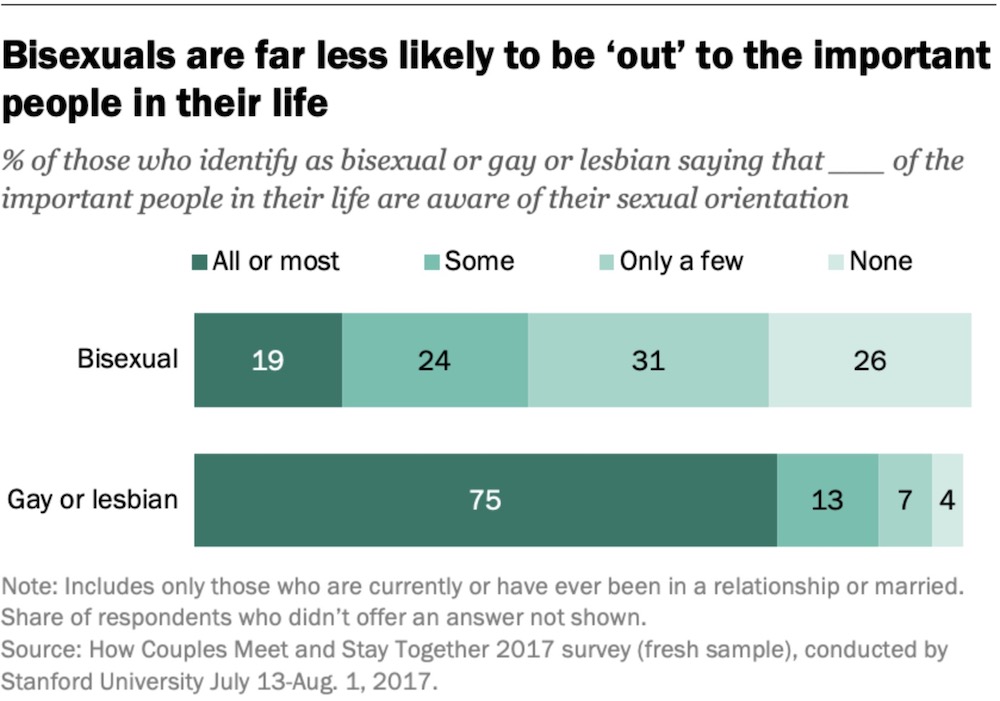
A lot of bisexual people report feeling invisible—as they’re either dating a man or a woman, people naturally assume they’re either straight or gay. According to the ONS, about 1.3% of the UK population identifies as bisexual, though the actual number is likely higher as many people feel uncomfortable disclosing their orientation. It is a wakeup call for everyone that you shouldn’t assume. Remember that there are people who identify as neither gay nor straight and be mindful that they might find it hard to “come out” if you’ve already started making assumptions.
Just because you’re attracted to both men and women doesn’t mean you’re polyamorous or want an open relationship so you can play both fields. Being polyamorous means you are open to having several partners at the same time. Being in an open relationship means you can have sexual relations outside your primary partnership. Just because bisexual people are attracted to people of more than one gender, it does not mean that they are polyamorous.
Due to feeling discriminated against or invisible, there are concerns that bi people are more likely to suffer anxiety and depression. A meta-analysis of population surveys in the United Kingdom found that bisexual individuals were more likely than monosexual individuals to meet criteria for being anxious or depressed, having low well-being, and endorsing symptoms of common mental disorders. For instance, lifetime rates of mood/anxiety disorders were found to be higher among bisexual-identified women (58.7%) compared to heterosexual women (30.5%).
Sadly, belonging to a sexual minority also leads to a bigger chance of being rejected by your family. In the UK, organisations like the Albert Kennedy Trust report that LGBTQ+ youth are disproportionately represented in the homeless population. About 24% of young people facing homelessness in the UK identify as LGBTQ+, with family rejection being a primary cause.
While creatives are often open-minded, the characters portrayed in movies and TV shows still adhere to stereotypes. While inclusion and diversity have become trending topics, and we see more representation on platforms like the BBC and Netflix UK, there is still progress to be made in depicting bisexual individuals, especially bi men of colour, in a nuanced way.
Even if you have support at home, ensure you join online and offline communities in the UK that support the LGBTQ+ community. Studies show that those who have social support have higher self-esteem and are overall happier. You can check out UK organisations like Stonewall, Bi Pride UK, and local resources like the London LGBTQ+ Community Centre.
UK health data suggests that people who identify as bisexual may sometimes engage in riskier sexual behaviours, possibly due to underlying reasons like depression or a lack of targeted health education. It’s important to remember that many STIs are transmitted through contact and not just penetration.
In the UK, the NHS offers the HPV vaccine to girls and boys, and it is also available for men who have sex with men (MSM) up to the age of 45 at sexual health clinics. You should also get regular cervical screenings (smear tests) if you have a cervix. These are free on the NHS and are vital for detecting early changes that could lead to cancer.
You should get tested regularly for any and all STIs at an NHS sexual health clinic (GUM clinic), even if you don’t have a long-term partner. Most STIs can be cured with antibiotics. For HIV, modern treatments available in the UK allow people to live long, healthy lives. If you are on effective treatment, your viral load becomes undetectable (U=U), meaning you cannot pass the virus on to sexual partners.
If you decide to have casual sex, practice safe sex. Use condoms for penetration and consider dental dams for oral sex. If using sex toys, wash them or use a new condom when switching between partners. For more detailed tips, you can check NHS sexual health resources or the Bisexual Resource Centre.
